FIFA World Cup 2026 Final Draw

Photography by: Gabriel Bayona Sapag
The draw for the 2026 FIFA World Cup was always going to be a spectacle. With 48 teams, 16 host cities, and what Gianni Infantino cheerfully called “104 Super Bowls,” Friday’s ceremony delivered its usual mix of pageantry, plot twists, and head-scratching moments. But beneath all the theatrics, one thing became clear: the expanded tournament has set the stage for a fascinating, unpredictable summer in North America — and the United States men’s national team may have landed one of the tournament’s most manageable paths.
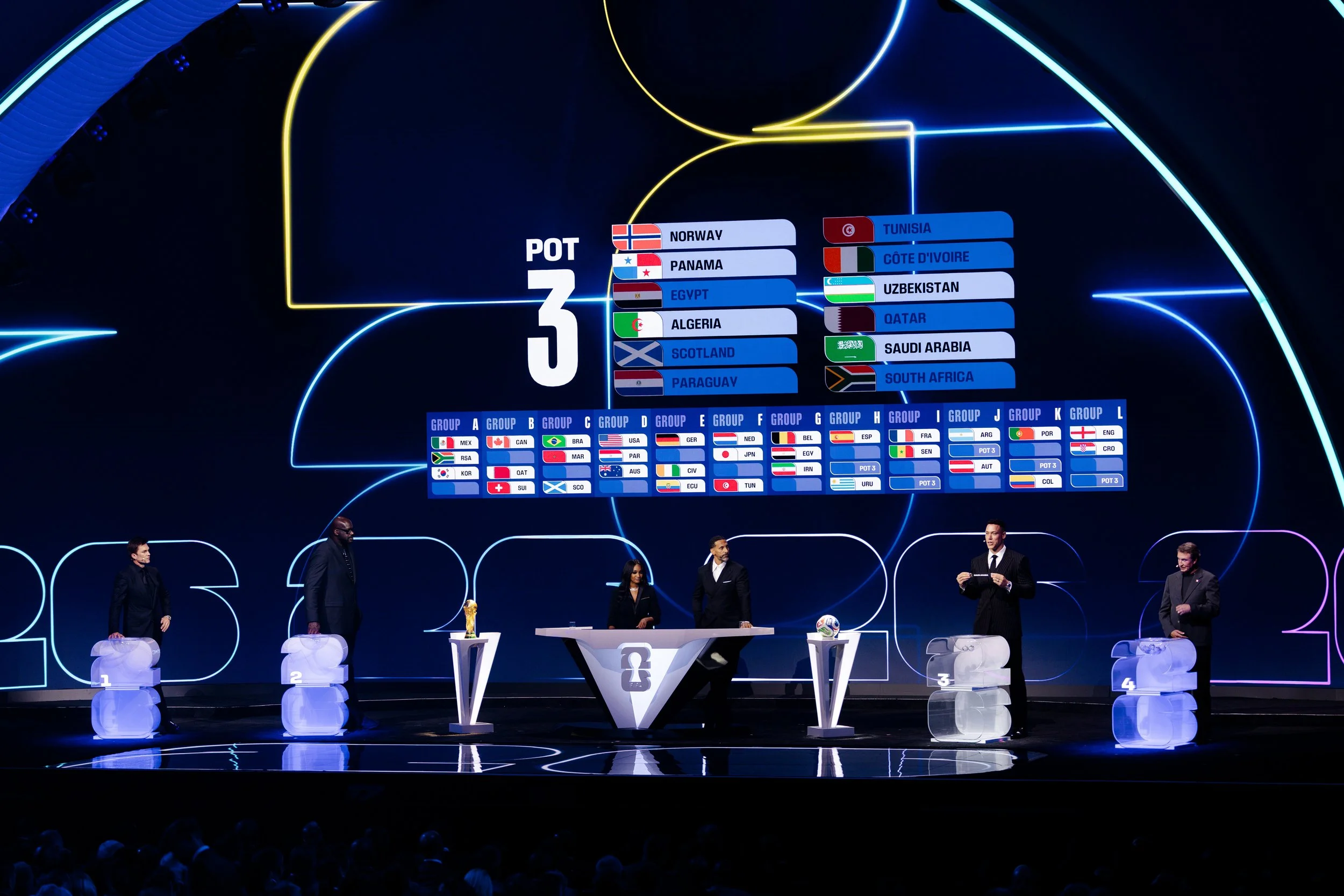
Group D places the U.S. alongside Paraguay, Australia, and a UEFA playoff winner (likely Turkiye). It’s a field filled with tricky but familiar opponents — and that familiarity may be the USMNT’s single biggest advantage. Mauricio Pochettino’s team has faced Paraguay and Australia in the last two months and played Turkiye in June. That’s 180 to 270 minutes of recent, real-time data against the three teams they’re now preparing for on the biggest stage.
Given how chaotic World Cup draws can be, this borders on ideal.
Not long ago, the U.S. looked nowhere close to ready for such a moment. Their early 2024 form — losses to Panama, Canada, Turkey, and Switzerland — sparked real panic. But under Pochettino, the script has flipped. A convincing win over Australia, a controlled victory against Paraguay, and that 5–1 dismantling of Uruguay in November have restored belief and given the Americans something they haven’t always possessed entering a World Cup: momentum.
















A Manageable Group — But No Margin for Error
Paraguay are stubborn and experienced, but they play conservatively and struggled for goals in CONMEBOL qualifying. Australia are organized and combative but lack star power. Turkiye, if they qualify, would be the highest-ranked of the three — and even then, the U.S. recently beat them 2-1 in a friendly.
This is the blueprint for a group the U.S. should win. And finishing first matters more than ever. With three teams advancing from many groups, topping Group D would likely pair the Americans with one of the tournament’s weaker third-place finishers in the new Round of 32. That’s not a luxury — it’s the cleanest possible route to the deeper knockout rounds.
The pressure, of course, cuts both ways. A slip-up on home soil would go down as one of the program’s most embarrassing setbacks since the 2018 qualifying disaster. But for the first time in a generation, the expectations match the opportunity.
Elsewhere, Mexico and Argentina Win Big
While the U.S. made out well in Group D, they weren’t the only beneficiaries of the expanded format.
Mexico landed perhaps the softest draw of any host nation. Opening against South Africa in the Azteca, then facing South Korea and a European playoff winner, El Tri avoided every elite team they could have faced. Given the altitude, the crowd, and the atmosphere Mexico City reliably delivers, they’ll have as big a home-field advantage as any team in the tournament. Winning the group would keep them in the capital through at least the Round of 16 — and anything less will be seen as a failure.
Argentina, meanwhile, should breeze through Group J. Algeria and Austria pose challenges, but neither looks equipped to derail the defending champions early. Jordan round out the group as one of the expanded field’s biggest beneficiaries.
On the opposite end of the spectrum sits Group I: France, Senegal, Norway, and the intercontinental playoff winner. Even with three teams capable of advancing, someone of real quality is going home early. For Senegal — a trendy dark-horse pick — the margin for error is microscopic.






Asia’s Contenders Face Mixed Fortunes
Across the AFC contingent, the draw delivered a blend of opportunity and risk.
Japan, drawn with the Netherlands, Tunisia, and a second European side, face a complicated but navigable path. After outplaying giants in 2022, they’ll believe they can do it again.
South Korea find themselves in one of the tournament’s more balanced groups, paired with Mexico, South Africa, and a European playoff winner that could include Denmark — a team strong enough to top the group if they get through.
Australia, who share Group D with the United States, may view their pairing as intimidating, but the Socceroos have reason for quiet confidence. They avoided a traditional world power and nearly beat the U.S. in September’s fiery friendly in Denver. Tony Popovic’s group lacks big-name stars, but they’re as resilient as any team in the field.



A Home World Cup, A Real Chance
The draw rarely delivers clarity, but Friday’s results gave the USMNT the one thing they needed most heading into a home World Cup: a plausible, achievable path.
Pochettino has preached evolution, identity, and adaptability. Now he gets three group-stage opponents he already knows well, and the U.S. gets the chance to control its own destiny. We all also get six months to dream, debate, and dissect every possible scenario.
It’s the world’s biggest tournament, in this country that’s been waiting decades to host it again. And thanks to Friday’s draw, the U.S. enters 2026 not just as a co-host — but as a real contender to make a deep, lasting impression.